PROYECTO DE INGLES
WHAT ARE YOUR MULTIPLE INTELLIGENCES?
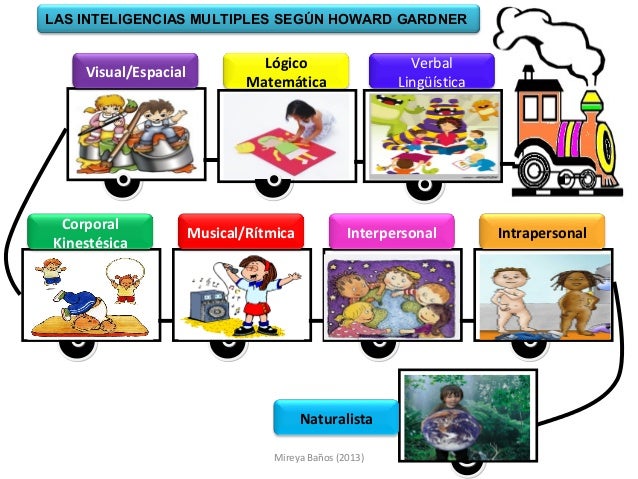
This diversity that students present could be related to the Theory of Multiple Intelligences proposed by the pedagogue and psychologist Howard Gardner in 1985 and that precisely affirms that all people have 8 types of intelligence: linguistic intelligence, mathematical logician, spatial, musical, cinephile -corporeal, interpersonal, intrapersonal and naturalistic. However, in each of us, some are more dominant than others, and therefore we will learn better if we favor access to content through activities linked to the most dominant intelligence. That is why, in our classes, we introduce a variety of activities that favor the different learning styles that our students present, and at the same time enhance those types of intelligence that are less developed.
EXAMPLES:
The study of the emotional factors was principle for the theory of multiple intelligences.
The teaching-learning process is based on the theory of multiple intelligences
It is possible that you have been asked (or yourself) many times this question, which we could translate as "What level of English do you have?" or “How well do you speak English?”, although literally it would be “How well can you speak English?”. It is usually one of the first verbs learned in this language, and we use it to refer to the capacity or ability to do something. In this blog post we are going to look at how and when to use “can” in English.
When do we use the verb can?"Can" is a modal verb and, like might and other modal verbs, it has different functions
-I can count to 30 in Russian
-Daniela can swim 100 lengths
-Theresa can swim very fast.
-I can play guitar
-You can cook very well
-The baby can walk
-We can travel by bus
-He can climb the tree.
-The can fix cars
-It can rain tomorrow
Here its negative form is “can’t
-I can't speak French at all -Ali can't play the piano-Jenny can't bake cakes-She can’t stay up all night.
-Michael can’t drive very well.
-She can’t walk
-I can’t play the trombone
-They can’t hear you
-I can’t end this way.
-We can’t visit Susan today


Comentarios
Publicar un comentario